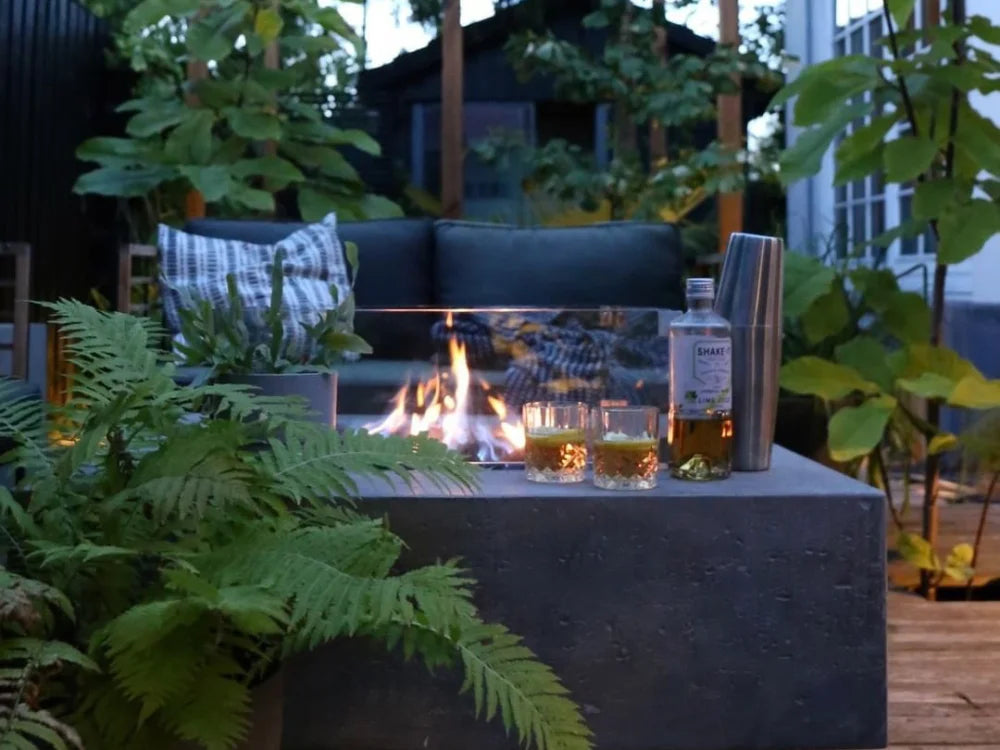
Planning a backyard fire pit? These 12 layout ideas — with real Elementi fire table picks for every yard shape — show how to size, place, and style your setup.
A fire pit can change how you use a backyard entirely — but the best setup isn't the biggest or most dramatic one. It's the one that fits your space.
A round fire table might anchor a cozy conversation area on a wide lawn. A rectangular one might make far better sense of a long, narrow side yard. Neither is "better" — they just solve different problems.
Start with your space, not the fire pit itself: how much room you actually have, where people already tend to sit, what else happens in that part of the yard, and how the fire feature will connect to everything around it. Get that right first, and picking the actual table gets a lot easier — we've pulled in real Elementi fire table examples for each layout below so you can see roughly what fits where.

1. Turn a Small Patio Into an Outdoor Living Room
A small patio doesn't need its own separate fire pit zone — and trying to carve one out usually just makes the space feel tighter.
The better move is to fold the fire pit into the seating you already have. A compact fire table works well between two lounge chairs, in front of a loveseat, or as the centerpiece of a small conversation set — it earns its spot by doing double duty as a side table when the flame's off.
Keep the surrounding furniture proportional to the space, and leave a clear path to move through. On a small patio, open floor reads as more valuable than one more chair.
Try this: the Manhattan 36" Concrete Fire Table is built for exactly this — a 36 × 36-inch square footprint with 45,000 BTUs, small enough to sit between two lounge chairs without swallowing the patio. Pair it with a loveseat, two lounge chairs, and one small side table. Nothing else — let the patio breathe.

2. Run a Rectangular Fire Table Down a Long, Narrow Yard
Long, narrow backyards fight against round seating arrangements, which tend to interrupt the natural line of the yard rather than work with it.
A rectangular fire table solves this by following the yard's own shape. Lay out the zones in sequence — house, dining area, fire table, then whatever's at the back of the lot, whether that's a garden bed or a view. Each section gets a job without the yard feeling chopped into disconnected rooms.
A rectangular table also pairs naturally with a sectional sofa, since both share the same straight lines.
Try this: a long outdoor sofa along one side, the Hampton 56" Concrete Outdoor Fire Table in front of it — its 56 × 32-inch profile is long enough to hold a sectional's full sightline — and a clear walking path behind the seating. The result reads more like an extension of the house than a fire pit dropped into the yard.

3. Build a Dedicated Fire Pit Zone in an Open Backyard
A big lawn gives you more freedom, but it can also work against you — a fire pit set in the middle of wide-open space can end up feeling stranded.
Give it a boundary instead. Pavers, gravel, stone, a cluster of seating, low planting, or an outdoor rug (where it makes sense) can all define the edges of a fire pit area without a single wall going up. You're essentially building a small outdoor room inside the larger yard, using furniture and ground material instead of construction.
Try this: a circular or square seating zone set into the lawn, with a larger-format piece like the Andes 66" Concrete Fire Table anchoring the center — 66 inches long, 60,000 BTUs, with the propane tank built into the base so nothing sits exposed on the lawn. For a yard large enough to need it, the Ravello 72" Fire Pit goes even bigger. Either way, leave enough open perimeter for people to move comfortably.

4. Connect the Fire Pit to Your Outdoor Dining Area
Your backyard doesn't need a hard line between "dining area" and "fire pit area" — most people move between the two in the same evening anyway.
A fire table is useful here specifically because it does both jobs: dinner surface first, fire feature after. One layout that works well is outdoor kitchen, then dining table, then fire table, then lounge seating. A simpler version skips the kitchen: dining area into fire table into conversation seating.
Either way, you get one continuous evening instead of two disconnected zones.
Try this: something with real tabletop presence, like the Warren 42" Propane Concrete Fire Table, picks up naturally where a dining set leaves off. Matching the frame finish to your dining furniture — even loosely — is enough to make the two areas feel like one space.

5. Make the Fire Pit Part of Your Poolside Setup
A pool already pulls focus, so the fire feature's job is to complement it, not compete with it.
The cleanest approach is a separate seating zone off to the side — pool, then lounge chairs, then fire table, then outdoor sofa. Round shapes tend to work best here because they create a natural gathering point without a hard directional line pulling attention away from the water.
Try this: the Lunar Bowl 42" Concrete Fire Table — a 42-inch round design at 45,000 BTUs — is sized to sit comfortably off to the side of a pool deck, visible from both the loungers and the nearby seating without blocking circulation around the water.

6. Design Around the View, Not Just the Flame
If your backyard has something worth looking at — a garden, a tree line, a lake, a sunset — don't let the fire pit hog all the attention.
Angle the seating so people can turn naturally between the fire and the view instead of facing the flame head-on all evening. A round or compact fire feature works well here because it doesn't force one fixed sightline the way a long rectangular table can.
Try this: the Columbia 42" Concrete Fire Table is round enough to let seating wrap around it loosely, so people can face the fire or the view depending on where they're sitting. The goal is people, fire, view — in that order — not people, fire, fence.

7. Turn an Unused Corner Into a Fire Pit Nook
Not every backyard needs the fire pit dead center. An awkward, underused corner often makes a better spot than the middle of the lawn.
An L-shaped sofa or two chairs set at an angle, with a compact fire table between them, turns dead space into the coziest seat in the yard — and it keeps the center of the backyard open for everything else: kids, pets, lawn games, gardening, or extra chairs when people show up.
Try this: the Modeno Aurora 34" Concrete Fire Table is compact enough to tuck into an angled seating arrangement without eating much floor space. Treat the corner as a small retreat rather than a formal entertaining spot — add a couple of comfortable chairs, soft lighting, and a bit of greenery, and that's usually enough.

8. Use a Pergola to Frame the Fire Pit Area
A pergola gives a backyard a clear architectural boundary when it doesn't already have one, and it works well paired with a fire feature as a secondary focal point.
One caution here: never assume a fire table can automatically go under a covered structure just because it's rated for outdoor use. Before you commit to this layout, check the manufacturer's clearance requirements, the fuel type, overhead clearance, and any local fire code or HOA restrictions. These vary by product and by location, so the manufacturer's spec sheet and your local codes should override any general layout advice — including this one.
9. Give the Fire Pit Some Privacy
A fire pit gets a lot more inviting once the space around it feels enclosed rather than exposed to a neighbor's window or the street.
Tall shrubs, a hedge, ornamental grasses, a few well-placed trees, a privacy screen, or existing fencing can all do the job. You don't need to block the view entirely — a partial screen is often enough to shift the mood from "on display" to "tucked away."
Try this: a sandstone-finish piece like the Riviera & Positano 60" Sandstone Fire Table reads more like a natural landscape feature than a manufactured fire pit, which helps it settle into a planted backdrop. Set it in front of a sectional or a run of lounge chairs, centered in the seating — a backyard retreat without a single permit required.

10. Match the Fire Table to What's Already There
A fire table doesn't need to match your patio exactly — but repeating one or two materials or tones across the space makes everything feel like it belongs together.
Elementi's fire tables come in a real range of finishes — smooth concrete, travertine, slate, wood grain, and natural rock textures, in light gray, dark gray, cream white, marble, and bronze. A few combinations that tend to work: gray pavers with a light-gray smooth-concrete table like the Wilton 35"; warm wood furniture with a neutral gray table so the wood stays the visual accent; or dark furniture with a black-and-white marble finish, like the Copenhagen 42" Marble Porcelain Fire Table, set against a lighter stone patio.
You're not trying to color-match everything — just find one or two threads that connect the fire table to the furniture, the patio surface, the house exterior, or the landscaping around it.
11. Keep the Layout Flexible for Everyday Life
Your backyard isn't used the same way every day. Four people around the fire one weekend, a dinner party the next, the kids taking over the whole patio the evening after that.
That's the case for movable furniture over anything built-in. A freestanding fire table, movable lounge chairs, a sectional that can shift, and a couple of small side tables give you a layout that adapts instead of one that's locked in place.
Try this: something lighter and lower-commitment, like the Boyle 28" Propane Concrete Column Fire Pit, moves easily when the layout needs to change — no gas line to trench, just a propane tank. Keep one side of the fire pit area open on purpose, so there's room to pull in extra chairs without rearranging everything else.

12. Plan the Fire Pit Area for After Dark
The best fire pit setup isn't only designed for the moment the flame goes on — it's designed for everything that happens before and after: dinner outside, a movie under the stars, a quiet drink with a book.
Lighting is what ties those moments together. Layer it instead of flattening everything with one bright source: soft ambient light, path lighting, string lights, a little accent lighting on the plants, and the fire itself as the natural centerpiece.
Try this: keep the light immediately around the fire pit low and let the flame be the brightest thing in the frame. A table with a protective lid — most Elementi models ship with a PVC or aluminum cover — also means the same surface can host that afternoon drink before it becomes the evening's fire.
How to Choose the Right Fire Pit Layout for Your Backyard
Before you shop for a fire pit, spend a few minutes with your actual space. Four questions to work through:
How much usable space do you really have? Measure the area where people will actually sit, not the total size of the yard. A big lawn can still have a small usable patio.
How many people do you normally have over? A couple might only need two chairs and a compact fire table like the Manhattan 36". A family that hosts often will want a larger footprint from the start — something in the 56–66 inch range, like the Hampton or Andes.
What else is happening in that part of the yard? A pool, an outdoor kitchen, a dining table, a patio door, a garden bed, open lawn, a view worth keeping clear — your fire pit should work with whatever's already there, not block it.
Do you want something permanent or something flexible? A built-in fire pit becomes part of the landscape. A freestanding table like the Boyle 28" keeps your options open if your needs change later. Neither is the "right" answer — it depends on how you actually use the yard.
Heat output is worth a quick word too: most fire tables run 40,000–60,000 BTUs, which covers the majority of backyard use. If you want serious heat for a large, open space, something like a 100,000 BTU model will out-produce the standard range — but more BTUs also means faster propane use, so match the output to the space rather than defaulting to the highest number. For a deeper side-by-side on shape, BTU, and fuel type, our full fire table buying guide walks through those trade-offs model by model.
Fire Pit Layout Ideas at a Glance
| Your Space | Layout to Consider | Example Elementi Pick |
|---|---|---|
| Small patio | Integrated seating area | Manhattan 36" |
| Long, narrow yard | Linear arrangement | Hampton 56" |
| Large open backyard | Dedicated fire zone | Andes 66" |
| Poolside | Secondary seating zone | Lunar Bowl 42" |
| Backyard with a view | Seating angled toward the view | Columbia 42" |
| Unused corner | L-shaped seating | Modeno Aurora 34" |
| Outdoor dining area | Dining + lounge connection | Warren 42" |
| Flexible family yard | Movable seating | Boyle 28" |
| Privacy-focused space | Enclosed seating zone | Riviera & Positano 60" |
| Modern patio | Coordinated materials | Copenhagen 42" |
Ready to see everything in one place? Browse the full Elementi fire table collection →
Before You Buy: 5 Things to Measure
A great-looking fire pit can still feel wrong if the space around it is too tight. Before you buy, measure:
- Available floor space — the actual footprint for the fire feature plus furniture, not just where you'd "like" it to go.
- Seating footprint — the fire table alone isn't the whole picture; count the chairs, the sofa, and the room people need to get around them.
- Walking paths — make sure the fire pit doesn't sit in the natural route between the house, patio, pool, kitchen, or garden.
- Required clearances — always follow the manufacturer's installation instructions; local codes may add further restrictions.
- Fuel setup — if you're considering propane or natural gas, plan where the tank or gas line connection will actually sit before you finalize the layout. Note that not every model converts between fuel types, so confirm the configuration before you buy.
Get these five right, and you avoid the most common mistake: picking the fire pit first and trying to force the rest of the yard to fit around it.
The Best Fire Pit Is the One That Fits How You Actually Live
There's no single correct backyard fire pit layout. A small patio does well with a compact fire table that pulls double duty as a surface. A long yard often works better with a rectangular design. A big lawn can support a full dedicated gathering zone, while a quiet corner might be all two people ever need.
The fire itself is only part of the question. Where will people sit? Where will they walk? What will they be looking at? What happens before the flame goes on, and after it goes out?
Answer those first, and choosing the actual fire pit gets a lot simpler. A well-designed fire pit area doesn't need to look staged — it just needs to feel like a natural part of the house, comfortable enough for a random Tuesday and flexible enough for the night everyone ends up outside.
Frequently Asked Questions
What's the best place to put a fire pit in a backyard? It depends on your layout and fire pit type, but look for a spot with comfortable seating access and clear circulation, while keeping all required clearances from structures and vegetation. Always follow the manufacturer's instructions and local codes.
Should a fire pit be in the center of a backyard? Not necessarily. Center placement works well on a large, open lawn, but a corner or patio-edge spot often makes better use of a smaller or more structured yard.
What should I put around my fire pit? Outdoor seating, pavers, gravel, stone, landscaping, and appropriate lighting are the standard combination — just make sure materials are rated for proximity to the fire pit and installed to spec.
What shape fire pit works best in a small backyard? A compact round or square design, like the Manhattan 36" or Lunar Bowl 42", tends to work best — the real limit is usually how much room is left for seating and movement, not the shape itself.
Can a fire pit go on a patio? Many fire pits and fire tables are rated for patio use, but the surface material, fuel type, required clearances, and local codes all matter. Check the product's installation instructions before placing it.
How do I make a fire pit area feel cozy? Start with seating close enough for real conversation, then layer in soft lighting, outdoor cushions, plants, and a side table or two — without crowding the space.


