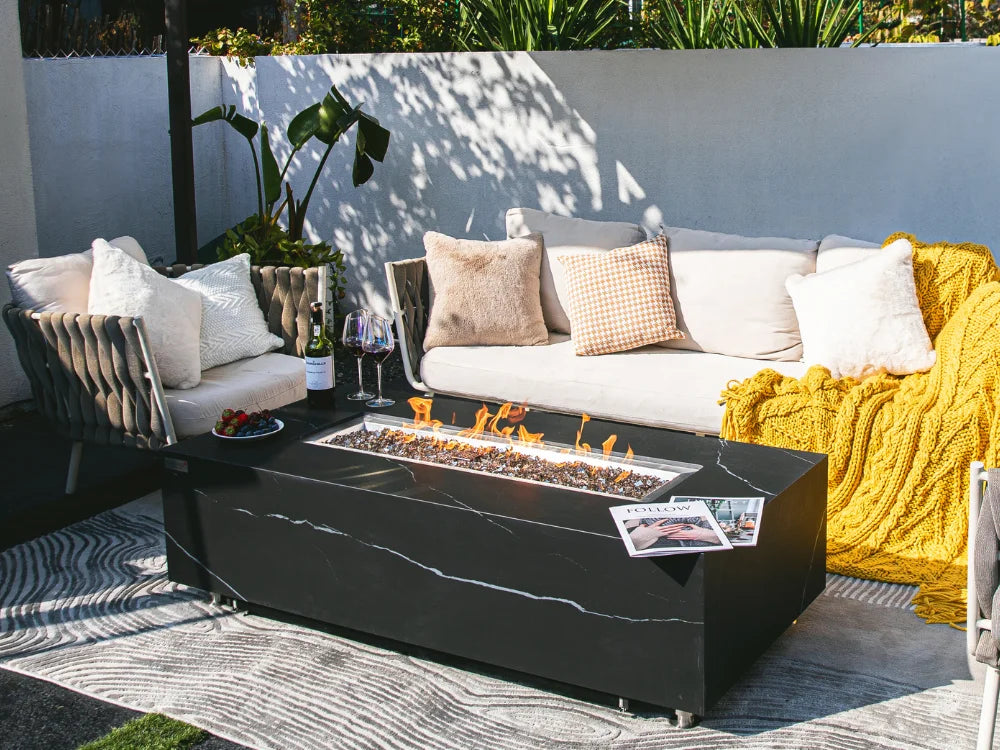
A propane fire table gives you instant flames, no ash and no wood to haul, and it doesn't need a permanent gas line. This step-by-step guide is written for homeowners setting up a propane fire table on a patio, using Elementi fire tables as the example.

Still deciding on fuel type or location? Start with our Gas Fire Pit Installation Guide: What to Know Before You Set Up Your Fire Table, then come back here for the hands-on setup.
Before You Start
Propane suits homeowners who don't have a natural gas line, want a flexible setup, or may rearrange their patio. If you'd rather connect to natural gas, that hookup should be done by a qualified gas professional in line with local code. Our installation guide covers how to choose between the two.
Set the table in its final spot on a level, stable surface before you connect anything, since concrete fire tables are heavy. Follow the clearance distances in your model's manual, and leave room to reach the propane tank.
What's in the Box
Take the Andes 66" Fire Table (OFG309) as an example:

- Handcrafted GFRC (glass fiber reinforced concrete) body
- Up to 45,000 BTU
- Built-in propane tank storage
- Lava rocks and a durable PVC cover included
- Glass wind screen, stainless steel burner pan lid and propane tank cover sold separately
Across the Elementi collection, output runs from 45,000 to 60,000 BTU. The Elementi Plus line delivers 60,000 BTU with push-button spark ignition and is CSA and CE certified.
Step 1: Connect the Propane Tank
- Place the tank in the storage compartment (models such as the Andes and Rocky 44" hide it out of sight) or beside the table.
- Connect the regulator and hose to the tank following your model's manual.
- Check every connection for leaks by brushing on soapy water and opening the valve. Bubbles mean a leak: close the valve and retighten. Never test with a flame.

Step 2: Add the Fire Media
- Spread the lava rocks evenly over the burner.
- Keep the burner openings clear.
- Use only fire media made for gas fire features.
Step 3: Test the Fire Table
- Open the valve and ignite the burner.
- Watch the flame. It should burn steadily with no strong gas smell.
- Test before your first gathering, not during it.
How Long Does a 20 lb Tank Last?
The simple formula: propane per hour ≈ BTU ÷ 21,500.

At 45,000 BTU that's about 2.1 lb per hour at full output, so a 20 lb tank gives roughly 9 to 10 hours at maximum flame. A 60,000 BTU Elementi Plus table uses about 2.8 lb per hour, or roughly 7 hours per tank. Turning the flame down stretches that further.
Layout Ideas That Work
- Sectional sofa: Hampton 56". A rectangular table suits a longer patio or outdoor sectional.
- Small patio or conversation circle: Lunar Bowl (round) or Manhattan 36". Compact tables keep everyone close to the flame.
- Tight corners: Boyle 28" column. A slim option for small spaces.
- Maximum heat: Rose Bowl 48". For anyone who wants more warmth than the typical 40,000 to 60,000 BTU table.
Leave a clear walkway around the table and keep the flame visible from every seat. On breezy patios, a glass wind screen helps, and Elementi offers model-specific wind screens for several tables.
Common Setup Mistakes
- Not planning tank access for connecting, swapping and refilling
- Blocking doors or walkways
- Skipping the leak test
- Skipping the cover. Weather is the fastest way to age a concrete table.
- Placing furniture too close. Use your model's clearance figures, not a rule of thumb.
Setup Checklist
- ✓ Level, stable, suitable surface
- ✓ Clearances checked against the manual
- ✓ Tank connected and leak-tested
- ✓ Lava rocks evenly spread
- ✓ Ignition and flame tested
- ✓ Cover on when not in use
Care and Maintenance
Inspect regularly (only when the fire is completely out):
- Check the burner is securely in place.
- Check the air mixer is clear of insects, spider nests and debris.
- Check all gas connections for leaks.
- Check the ignition sparks properly.
- Look for damage, rust or excessive wear. If you find any, don't operate the table until it's repaired.
Never tamper with the appliance. Any faulty part should be replaced with a manufacturer-approved part, and Elementi's team can help with technical support.
Clean the surface:
- Mix mild dish soap into warm water and wipe with a soft cloth or sponge.
- Rinse with a damp cloth, then dry completely to avoid water spots.
- Blot spills right away so they don't soak into the concrete.
- Avoid petroleum-based or abrasive cleaners, harsh brushes and rough sponges.
- Don't slide objects across the surface, and don't place food on it or eat from it.
Stainless steel: Clean with warm soapy water and a soft cloth, working in the direction of the polish lines. Near the coast, clean stainless steel at least every two weeks. It resists corrosion but isn't rust-proof, and salt air and sea spray will cause surface rust if it's neglected.
Seal the concrete: Apply a water-based sealer about every six months. Wipe it on lightly with a soft rag in a dust-free setting, then wipe off any residue once the surface has dried completely.
Expect some change: After repeated use, slight discoloration of the finish can occur.

Winter and Long-Term Storage
- Wait until the fire is completely out and the table is cool to the touch before moving or storing it.
- Turn the gas off at the tank, disconnect the tank, and store it in a cool, dry place outdoors, away from children.
- Remove the rock filler and store it flat to prevent breakage.
- Cover the table whenever it's not in use, and store it indoors over winter if you can. Extreme cold can crack the tabletop.
Find Your Fire Table
Browse the full range of Elementi gas fire pits, or take a look at the Andes 66" with built-in tank storage and the Lunar Bowl round fire table.
FAQ
Can I install a propane fire table myself?
In most cases, yes: position it, connect the tank, add the media and test. Always follow your model's manual.
Is the propane tank included?
Check the individual product page, as tanks are typically sold separately.
How long does a 20 lb tank last?
Roughly 9 to 10 hours at full output on a 45,000 BTU table.
Can I leave my fire table outside in winter?
It's better not to. Disconnect the tank, remove the rocks, cover the table and store it indoors if possible. Extreme cold can crack the tabletop.
Do I need to seal the concrete?
Elementi recommends a water-based sealer about every six months to protect the surface.
Can I eat or serve food on the table?
No. Keep food off the fire table surface.
How do I clean it?
Mild dish soap, warm water and a soft cloth. Avoid abrasive or petroleum-based cleaners.
Does a bigger tank make the fire hotter?
No. Heat output is set by the burner's BTU rating; a bigger tank only lasts longer.
Where can I buy a wind screen?
Model-specific glass wind screens are sold separately for several Elementi tables.

